
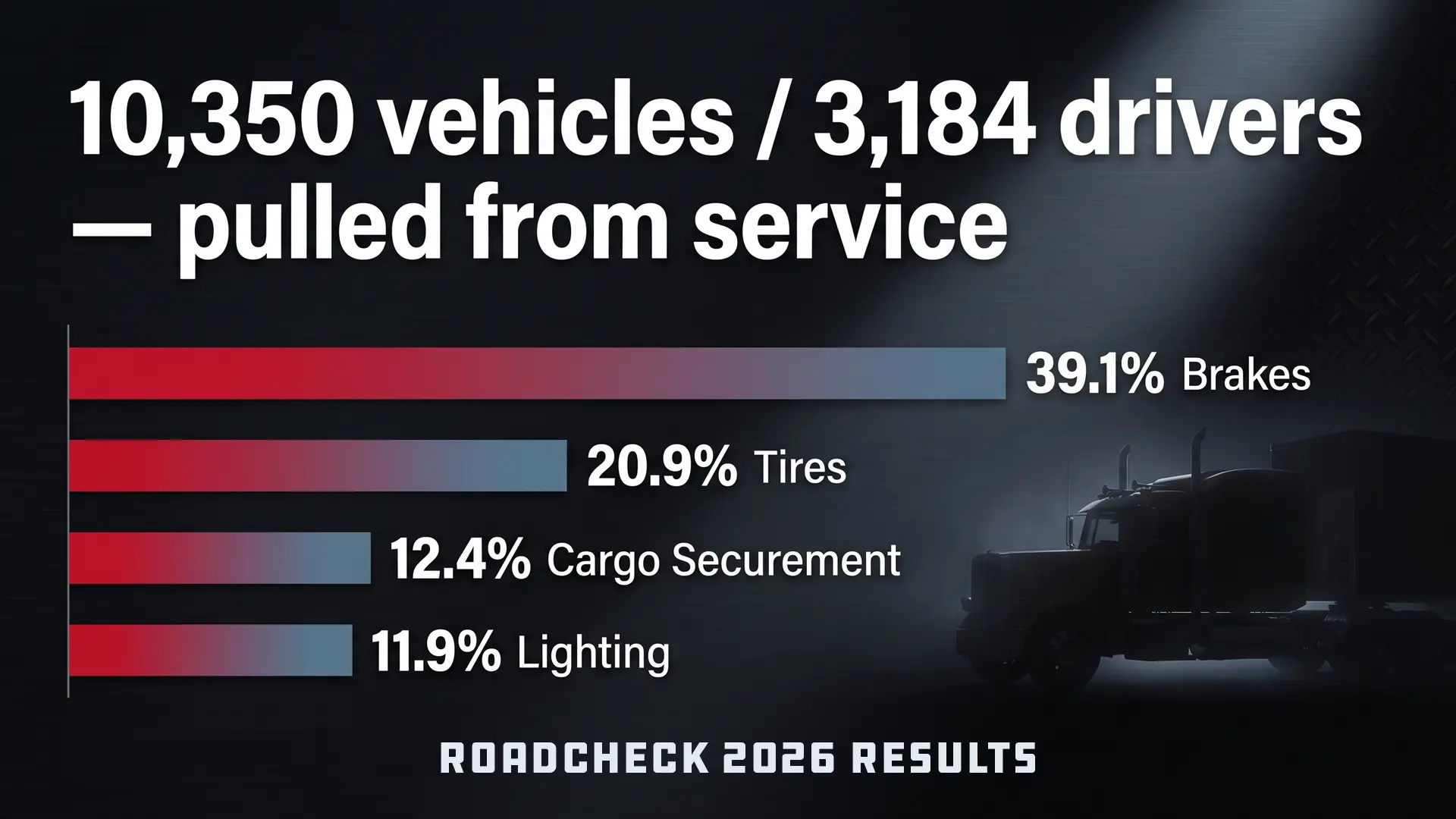
During this year's three-day International Roadcheck, certified inspectors conducted 54,575 roadside inspections across the U.S., Canada, and Mexico — and sidelined 10,350 commercial motor vehicles and 3,184 drivers for safety violations serious enough to warrant an out-of-service order. Brakes were the single largest driver of those numbers, accounting for 39.1% of every vehicle pulled from service. For fleet risk managers, the data is a free, continent-wide audit of exactly where enforcement — and liability — is concentrated right now.
What Is CVSA's International Roadcheck?
The Commercial Vehicle Safety Alliance (CVSA) runs International Roadcheck once a year: a coordinated, 72-hour blitz where certified inspectors across North America pull commercial vehicles and drivers for on-the-spot inspection. Vehicles that pass without a critical violation get a CVSA decal (U.S. and Canada only — Mexico doesn't participate in the decal program). Vehicles or drivers with a critical violation are placed out of service on the spot, meaning the truck doesn't move again until the defect is fixed.
This year, 81% of inspected vehicles and 94.2% of inspected drivers passed clean. The other 19% and 5.8%, respectively, are where the story — and the risk exposure — lives.
What Were the Top Vehicle Violations in Roadcheck 2026?
Four categories accounted for the overwhelming majority of vehicle out-of-service orders:
- Brakes — 39.1%. Brake system problems and defective brakes (defined as 20%+ of a vehicle's brakes showing an out-of-service condition) totaled 5,451 violations, making brakes the leading mechanical reason vehicles were pulled from service for the [15th consecutive year, per CVSA's own reporting](https://www.ccjdigital.com/regulations/safety-compliance/video/15823091/how-to-pass-a-2026-roadcheck-inspection).
- Tires — 20.9%. The second most common defect category.
- Cargo securement — 12.4%. Freight that was improperly tied down, restrained, or monitored.
- Lighting — 11.9%. Defective or missing lighting equipment.
Cargo securement got explicit special attention this year, with inspectors citing 1,724 out-of-service violations specifically for improperly secured freight — a signal that securement is moving from a background category to a named enforcement priority.
What Were the Top Driver Violations in Roadcheck 2026?
Driver-related out-of-service orders skewed toward paperwork and credentialing failures as much as behavior:
- No valid medical card — 27% of all driver OOS orders, the single largest category.
- Hours-of-service violations — 23.4%.
- Driving without a commercial license — 15.6%.
- English proficiency issues — 9.1%.
- Falsified logs — 6.7%.
Inspectors also issued 146 out-of-service orders specifically for tampering with electronic logging devices, and 667 seat belt citations across the three countries. In hazmat sweeps, inspectors reviewed 2,590 transport vehicles and flagged 141 hazmat-specific violations — most tied to missing or improper warning placards. Passenger-carrying vehicle checks produced 28 vehicle and 8 driver out-of-service orders across 458 inspections.
What Do the Roadcheck 2026 Results Mean for Your Fleet's Risk Profile?
Roadcheck is a snapshot, not a random sample — but it's a snapshot built from 54,575 real inspections, and the pattern is consistent with prior years: brakes, tires, and paperwork compliance (medical cards, HOS, ELD integrity) are where fleets bleed out-of-service orders, CSA points, and insurance scrutiny. Every out-of-service order is a data point an underwriter can pull at renewal. A fleet with a clean brake and cargo securement record walks into that renewal conversation with leverage; a fleet with recurring violations walks in exposed.
The cargo securement emphasis is worth flagging specifically for any fleet running flatbed, heavy haul, or mixed freight — 1,724 OOS violations in three days is not a rounding error, and it's the category most directly addressed by structured, hands-on load securement training rather than a policy memo.
How Can Fleet Safety Training Reduce Roadcheck Violations?
Most of what Roadcheck measures isn't bad luck — it's trainable. DriveTeam's Corporate programs map directly onto the categories driving this year's numbers:
- FMCSR training addresses the compliance fundamentals behind medical card, HOS, and credentialing violations — the single largest slice of driver OOS orders.
- Load Securement training targets the exact defect category CVSA called out for special emphasis this year, with hands-on instruction in tie-down, restraint, and load monitoring standards.
- Baseline/ProDriver Hands-On training builds the pre-trip inspection habits that catch brake and tire defects before a CVSA inspector does — inspection discipline that shows up in insurance conversations, not just Roadcheck scorecards.
If your fleet has any exposure in the categories above, now — while this year's numbers are fresh — is the moment to have that conversation internally.
Frequently Asked Questions
What percentage of vehicles passed Roadcheck 2026 with no violations?
About 81% of inspected commercial vehicles and 94.2% of inspected drivers had no critical violations during this year's International Roadcheck.
What was the leading reason vehicles were placed out of service in Roadcheck 2026?
Brakes. Brake system problems and defective brakes accounted for 5,451 violations — 39.1% of all vehicle out-of-service orders — making brakes the top mechanical issue, ahead of tires (20.9%), cargo securement (12.4%), and lighting (11.9%).
What was the top driver-related violation in Roadcheck 2026?
Operating without a valid medical card, which accounted for 27% of all driver out-of-service orders — more than hours-of-service violations (23.4%) or driving without a commercial license (15.6%).
Why did cargo securement get special emphasis this year?
CVSA and inspectors specifically flagged cargo securement as a 2026 enforcement focus, resulting in 1,724 out-of-service violations for freight that was improperly tied down, restrained, or monitored.
More From Our Blog

October Is National Pedestrian Safety Month — Here’s What Drivers Need to Know
October doesn't just mean cooler mornings and changing leaves. It's National Pedestrian Safety Month, and the roads carry more foot traffic than almost any other time of year — school pickup lines, sports practices, trick-or-treaters, and Halloween night itself. NHTSA...

Fall Driving Safety Tips: 8 New Hazards Every Driver Needs to Know
The 100 Deadliest Days are over. Fall driving risk is just getting started. As the school-year routine settles in and the 100 Deadliest Days of Summer fade into the rearview mirror, it's tempting to assume the riskiest stretch of the driving year is behind us. It...

Brake Safety Isn’t a One-Week Event: What Fleet Managers Should Take from CVSA’s Brake Safety Week
Brake Safety Week Ends August 29. Brake Safety Doesn't. Every year, the Commercial Vehicle Safety Alliance's Brake Safety Week puts a spotlight on one of the most consistent causes of commercial vehicle out-of-service violations: brakes. For seven days, inspectors...