

Safe following distance is one of the most effective — and most ignored — crash prevention tools available to every driver. The standard recommendation is **at least four seconds of following distance** between your vehicle and the one ahead, measured using a fixed roadside object. That four-second window is the difference between having time to react and becoming part of a chain-reaction crash.
Most drivers significantly underestimate how far behind they're actually traveling — and they find out how wrong they were the moment traffic stops.
What Is the Safe Following Distance While Driving?
Safe following distance is the amount of space — measured in time, not car lengths — between your vehicle and the vehicle directly ahead. Transportation safety professionals recommend a minimum of **four seconds** in normal conditions, because time-based measurement automatically adjusts as your speed changes.
The reason we use seconds instead of feet: at 30 mph, four seconds equals roughly 176 feet. At 70 mph, that same four seconds is over 400 feet. No static measurement works across all speeds. Time does.
Why Is Distracted Driving So Dangerous — Even at Low Speeds?
Speed doesn't determine danger. Awareness gaps do. At 5 mph in a parking lot, a driver who fails to check their environment before moving has already lost the margin they need to react. Pedestrians — especially children — can cross behind a vehicle in under two seconds. A shopping cart in a blind spot doesn't announce itself. Another vehicle completing a reverse maneuver at the same moment creates a collision with zero warning time.
Cognitive distraction is the most insidious of the three types because it doesn't require looking away. A driver who has just been scrolling their phone carries a residual mental load — what researchers sometimes call "attention residue" — that impairs situational awareness for seconds after they put the phone down. They look in the mirror, but they don't fully process what they see.
What Is the Four-Second Rule?
The four-second rule is the simplest and most reliable method for measuring following distance while driving. Here's how to apply it:
- Pick a fixed reference point ahead — a sign, overpass, shadow line, or utility pole.
- The moment the vehicle in front of you passes that object, begin counting: one-thousand-one, one-thousand-two, one-thousand-three, one-thousand-four.
- If you reach that same object before you finish counting, you're following too closely.
- Adjust your speed and repeat until you consistently clear four seconds.
That's it. No math, no guesswork — it's a self-calibrating system that works at any legal speed.
When Four Seconds Isn't Enough
Four seconds is the floor, not the ceiling. Professional drivers routinely extend to six seconds or more when any of the following conditions are present:
Weather and Road Conditions
- Rain, snow, or ice — stopping distances increase dramatically on slick surfaces
- Fog or reduced visibility — you need more time to see what you can't yet see
- Nighttime driving — reaction time is longer when hazards appear in headlights
Vehicle Load and Configuration
- Towing a trailer
- Hauling heavy loads
- Operating a large commercial vehicle
**Traffic Environment**
- Highway speeds
- Stop-and-go traffic where sudden stops are common
- Following motorcycles or cyclists, whose stopping behavior differs from passenger vehicles
When in doubt, add time. Space is the cheapest safety upgrade available.
Why Tailgating Causes Rear-End Collisions
Tailgating isn't aggressive driving — it's dangerous driving. When a driver follows too closely, they eliminate the time buffer they need to respond to traffic changes ahead.
The chain of failure looks like this: a vehicle stops suddenly → the tailgating driver sees the brake lights → the driver begins processing the situation → the driver initiates braking → the vehicle actually slows. Every link in that chain requires time. Tailgating removes it.
Rear-end collisions are among the most common and most preventable crash types on U.S. roads. The physics don't negotiate. An additional two seconds of following distance can mean the difference between a controlled stop and an impact.
Beyond crash risk, tailgating:
- Reduces your ability to see hazards developing in the lanes ahead
- Eliminates escape route options if you need to change lanes
- Increases stress for both the tailgating driver and the driver being followed
- Forces harder, more abrupt braking — which increases wear and fuel consumption
Following Distance Benefits Beyond Safety
Most drivers think about following distance only in terms of crashes. But the habit delivers a second set of benefits that matter on every commute.
Fuel and Mechanical Efficiency
Maintaining proper spacing encourages smoother acceleration and braking. Smooth driving reduces hard stops, which lowers brake and tire wear and improves fuel economy — measurably so on longer trips.
Driver Stress Reduction
Space creates calm. When you're not riding someone's bumper, you're not white-knuckling the steering wheel waiting for their brake lights. The road feels more manageable.
Passenger Comfort
Smooth following distance means smooth rides. Less hard braking. Fewer lurching stops. Your passengers — and your back — will notice.
How Professional Drivers Think About Following Distance
Professional drivers — commercial operators, fleet drivers, emergency responders — don't wait to react. They build following distance specifically to expand their decision-making window.
The questions they ask constantly:
- "If the vehicle ahead stops right now, do I have enough time and space?"*
- "Can I see around or beyond the vehicle in front of me?"*
- "Do I have an escape route if I need one?"*
This is what DriveTeam calls Decision-Based Driving — the recognition that driving is not a reaction sport. It's a decision sport. Proper following distance is the single most actionable way to expand that decision window every time you get behind the wheel.
Make the Four-Second Rule Automatic
The best driving habits are the ones you stop thinking about — because they've become instinct.
Pick a fixed object. Count to four. Adjust. Repeat. Do it every time you get on the road until it's no longer a conscious choice. At that point, you've made your vehicle — and everyone around you — measurably safer.
Four seconds. That's what it costs. That's what it buys.
DriveTeam trains drivers at every level — from teen license candidates to corporate fleet operators — to build exactly these kinds of high-stakes decision skills. If your team is on the road, we should talk.
Teen Driver Programs → driveteam.com/teen/
Corporate Fleet Training → driveteam.com/corp/
E.R.O.C. Police, Fire & EMS → driveteam.com/e-r-o-c/
Contact Us → driveteam.com/contact-us/
Frequently Asked Questions
What is the safe following distance while driving?
The standard safe following distance is at least four seconds between your vehicle and the vehicle ahead, measured by timing how long it takes you to reach a fixed object the front vehicle just passed. In adverse conditions — rain, snow, fog, highway speeds, or when towing — increase to six seconds or more.
What is the proper following distance when driving?
The proper following distance is a minimum of four seconds in normal conditions. This is measured using the four-second rule: when the vehicle ahead passes a fixed reference point, begin counting. If you reach that point before finishing the count, you're too close. Adjust speed and repeat.
Why do we use seconds instead of car lengths to measure following distance?
Car lengths are a fixed measurement that doesn't account for speed. At higher speeds, you need far more physical distance to stop safely. The four-second rule self-adjusts — four seconds at 30 mph equals roughly 176 feet, while four seconds at 70 mph equals over 400 feet. Time-based measurement is always accurate, regardless of speed.
How does following distance prevent rear-end collisions?
Rear-end collisions happen when a driver doesn't have enough time to perceive a hazard, decide to brake, and stop the vehicle before contact. Maintaining four seconds of following distance provides the reaction and braking time needed to stop safely in most conditions.
When should I increase my following distance beyond four seconds?
Increase to six seconds or more when driving in rain, snow, ice, fog, or darkness; when towing or hauling heavy loads; when driving a large commercial vehicle; or when traveling at highway speeds. When conditions deteriorate, the minimum becomes the floor, not the target.
Does following distance affect fuel efficiency?
Yes. Maintaining proper following distance reduces the frequency of hard braking and sudden acceleration, both of which burn more fuel. Drivers who maintain consistent spacing often see improved fuel economy and reduced brake wear over time.
More From Our Blog

October Is National Pedestrian Safety Month — Here’s What Drivers Need to Know
October doesn't just mean cooler mornings and changing leaves. It's National Pedestrian Safety Month, and the roads carry more foot traffic than almost any other time of year — school pickup lines, sports practices, trick-or-treaters, and Halloween night itself. NHTSA...

Fall Driving Safety Tips: 8 New Hazards Every Driver Needs to Know
The 100 Deadliest Days are over. Fall driving risk is just getting started. As the school-year routine settles in and the 100 Deadliest Days of Summer fade into the rearview mirror, it's tempting to assume the riskiest stretch of the driving year is behind us. It...
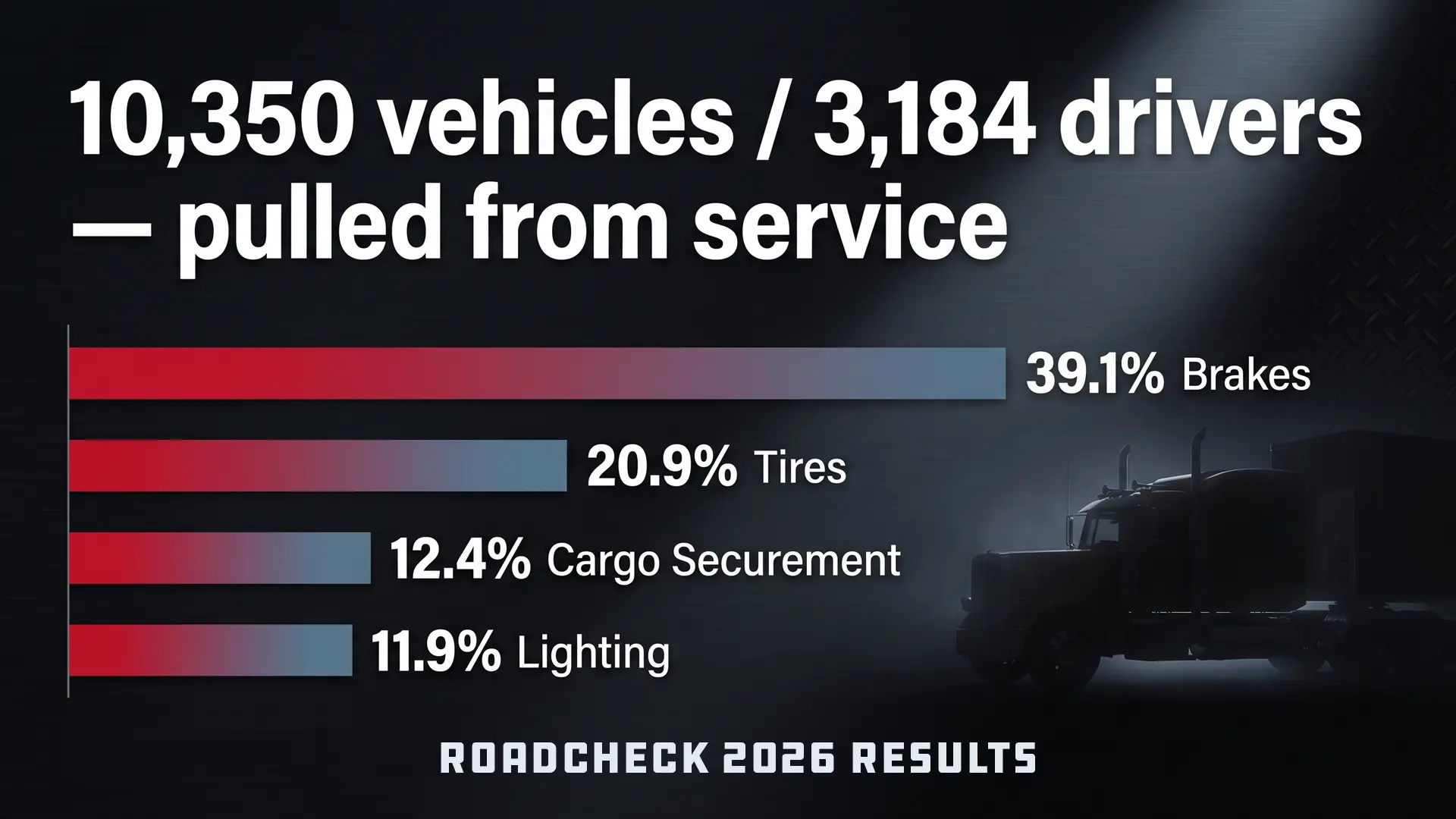
Roadcheck 2026 Results: What 10,000 Grounded Trucks Reveal About Your Fleet’s Risk
During this year's three-day International Roadcheck, certified inspectors conducted 54,575 roadside inspections across the U.S., Canada, and Mexico — and sidelined 10,350 commercial motor vehicles and 3,184 drivers for safety violations serious enough to warrant an...