

Operation Safe Driver Week runs July 12–18, 2026, and for one week, law enforcement agencies across the U.S., Canada, and Mexico put a spotlight on something that's true every other week of the year too: driver behavior, not vehicle condition, causes most crashes. NHTSA attributes roughly 94% of crashes to driver actions or decisions, and CVSA's 2026 enforcement focus — reckless, careless, or dangerous driving — is built entirely around that fact.
Whether you drive a personal vehicle, a company truck, or an emergency response vehicle, the habits that keep you out of a citation this week are the same habits that keep everyone on the road alive every week.
What Is Operation Safe Driver Week?
Operation Safe Driver Week is an annual enforcement and education campaign run by the Commercial Vehicle Safety Alliance (CVSA), in partnership with the Federal Motor Carrier Safety Administration. Launched in 2007, it's the only major CVSA campaign that targets *how* people drive rather than the mechanical condition of the vehicle — and unlike Brake Safety Week or International Roadcheck, it applies to commercial and passenger vehicles equally.
For 2026, CVSA's official area of emphasis is reckless, careless, or dangerous driving — the third consecutive year the alliance has chosen that theme. Officers will be watching for:
- Speeding
- Distracted driving
- Following too closely
- Aggressive or reckless driving
- Failure to wear a seat belt
- Fatigued or impaired driving
- Disregarding traffic signals
The numbers explain why CVSA keeps returning to these behaviors. Speeding was a factor in roughly 29% of U.S. roadway fatalities in 2024, and distracted driving contributed to over 3,200 deaths that same year. For commercial drivers, a citation during this week doesn't stay contained to the week — it feeds directly into Compliance, Safety, Accountability (CSA) scoring, with effects that compound over time.
What Is Defensive Driving?
Defensive driving is the practice of anticipating hazards and other drivers' mistakes before they happen, rather than simply reacting once they do. It's built on a few core habits: scanning well ahead of your vehicle, maintaining space around it, and always having an escape route if something goes wrong.
The distinction matters because most drivers think of "safe driving" as avoiding mistakes. Defensive driving goes a step further — it assumes *other* drivers will make mistakes, and it builds in the time and space to absorb them without a crash. That mindset is the foundation for every habit below.
The Six Habits of Safe Drivers
Every one of the behaviors CVSA is watching for this week is preventable. Here's what actually prevents them.
1. Stay Focused
Driving deserves your full attention, and most distraction happens before a driver even means for it to. Handle your phone, navigation, mirrors, climate controls, and loose cargo before you're moving. When your eyes leave the road for even a few seconds, hundreds of feet can pass without you seeing what's ahead of you.
2. Maintain Proper Following Distance
The simplest, most effective crash-prevention tool available to any driver is space. DriveTeam recommends a minimum four-second following distance in normal conditions — read our full breakdown of the four-second rule and how to apply it Increase that window in rain, snow, heavy traffic, or when driving a larger vehicle.
3. Drive at a Safe Speed
Speed limits are calibrated for ideal conditions — not the conditions you're actually driving in. Adjust down for traffic, weather, visibility, construction zones, and road surface. Arriving a few minutes later beats not arriving at all, and it's the single fastest way to fall outside CVSA's enforcement focus this week.
4. Expect Other Drivers to Make Mistakes
This is defensive driving in practice. Look well ahead, watch for sudden lane changes, hard braking, distracted drivers, pedestrians, cyclists, and motorcyclists — and always have an escape plan before you need one.
5. Eliminate Backing Risks
A disproportionate share of fleet crashes happen while backing at low speed, precisely because drivers underestimate the risk at low speed. Get out and look, use a spotter whenever one's available, back slowly, and avoid backing altogether when there's a safer alternative. The safest backing maneuver is often the one you never make.
6. Make Good Decisions Before You Start Driving
The safest drivers don't just react well — they prepare well. Before you start the engine: Are you rested? Distracted? Is the vehicle ready? Do you have enough time and a planned route? Safe driving starts before the engine starts.
What Is a Fleet Safety Program, and Why Does It Matter?
A fleet safety program is a structured, ongoing set of policies, training, and accountability measures a company uses to reduce crash risk across its drivers and vehicles — as opposed to a one-time orientation or a policy document that sits in a drawer. The distinction matters because Operation Safe Driver Week exposes exactly which companies have one and which don't.
The organizations that come through enforcement weeks like this one clean aren't the ones who drove carefully for seven days. They're the ones whose drivers operate this way year-round, because the training is built into how the company operates — not bolted on for a campaign.
How Can Employers Improve Fleet Safety?
Reducing crashes at the organizational level takes more than a memo. The companies with the greatest reductions in incidents consistently combine:
- Hands-on driver training — not just classroom instruction, but controlled-environment exposure to the situations drivers actually face (skid recovery, backing, weight transfer, braking dynamics)
- Ongoing coaching, not a single onboarding session
- Leadership involvement in setting and modeling safety expectations
- Regular safety communication, tied to real enforcement moments like Operation Safe Driver Week
- Performance accountability, so safe driving is measured, not just encouraged
DriveTeam's Corporate Division builds exactly this kind of program — Baseline, Advanced, and ProDriver hands-on training, FMCSR compliance instruction, load securement, and winter skills, all built around your fleet's actual equipment and routes. See the full Corporate Division training lineup →
How DriveTeam Teaches Safe Driving
At DriveTeam, we go beyond teaching someone how to operate a vehicle. Every program — Teen, Corporate, or E.R.O.C. — is built around the same core skill set:
- Vehicle control under pressure
- Hazard recognition
- Decision-making under time constraints
- Emergency braking and skid recovery
- Backing and space management
- Defensive driving habits that hold up outside the classroom
Our hands-on training puts drivers into controlled versions of the situations that cause real crashes — so the first time they encounter a skid, a sudden stop, or a tight backing maneuver isn't on a public road with no instructor beside them.
Teen Driver Programs → driveteam.com/teen/
Corporate Fleet Training → driveteam.com/corp/
E.R.O.C. Police, Fire & EMS → driveteam.com/e-r-o-c/
Contact Us → driveteam.com/contact-us/
This Week's Challenge
Operation Safe Driver Week ends July 18, but the habits shouldn't. Pick one this week and make it automatic:
- Put the phone away before you start driving, not after
- Leave four seconds of following distance, every time
- Slow down before conditions force you to
- Do a quick vehicle walk-around before you drive
- Plan the trip and the route before you need to
Small, consistent improvements are what actually move the fatality numbers — not a single clean week in July.
Drive safely. Stay alert. Make good decisions.
— DriveTeam
Frequently Asked Questions
What is Operation Safe Driver Week?
Operation Safe Driver Week is an annual enforcement and education campaign led by the Commercial Vehicle Safety Alliance (CVSA), running July 12–18, 2026. Unlike CVSA's vehicle-focused campaigns, it targets unsafe driving behavior in both commercial and passenger vehicles across the U.S., Canada, and Mexico.
What is the 2026 focus area for Operation Safe Driver Week?
CVSA's 2026 area of emphasis is reckless, careless, or dangerous driving — the third consecutive year the alliance has selected that theme. Officers will specifically be watching for speeding, distracted driving, following too closely, aggressive driving, seat belt violations, and fatigued or impaired driving.
What is defensive driving?
Defensive driving is the practice of anticipating hazards and other drivers' mistakes before they occur, rather than reacting after the fact. It's built on scanning ahead, maintaining space around your vehicle, and always having an escape route available.
What is a fleet safety program?
A fleet safety program is a structured, ongoing combination of policies, hands-on training, coaching, and accountability measures a company uses to reduce crash risk across its drivers — distinct from a one-time orientation or a written policy with no active training behind it.
How can employers improve fleet safety?
Employers see the greatest reductions in crashes when they combine hands-on driver training, ongoing coaching (not just onboarding), visible leadership involvement, regular safety communication, and measurable performance accountability.
Does a citation during Operation Safe Driver Week affect a commercial driver's record?
Yes. For CDL holders, moving violations issued during roadside enforcement — including during Operation Safe Driver Week — feed into the Compliance, Safety, Accountability (CSA) Safety Measurement System and can affect a carrier's score well beyond the campaign week itself.
Learn More: Corporate Fleet Training
Learn More: Teen Driving Training
More From Our Blog

October Is National Pedestrian Safety Month — Here’s What Drivers Need to Know
October doesn't just mean cooler mornings and changing leaves. It's National Pedestrian Safety Month, and the roads carry more foot traffic than almost any other time of year — school pickup lines, sports practices, trick-or-treaters, and Halloween night itself. NHTSA...

Fall Driving Safety Tips: 8 New Hazards Every Driver Needs to Know
The 100 Deadliest Days are over. Fall driving risk is just getting started. As the school-year routine settles in and the 100 Deadliest Days of Summer fade into the rearview mirror, it's tempting to assume the riskiest stretch of the driving year is behind us. It...
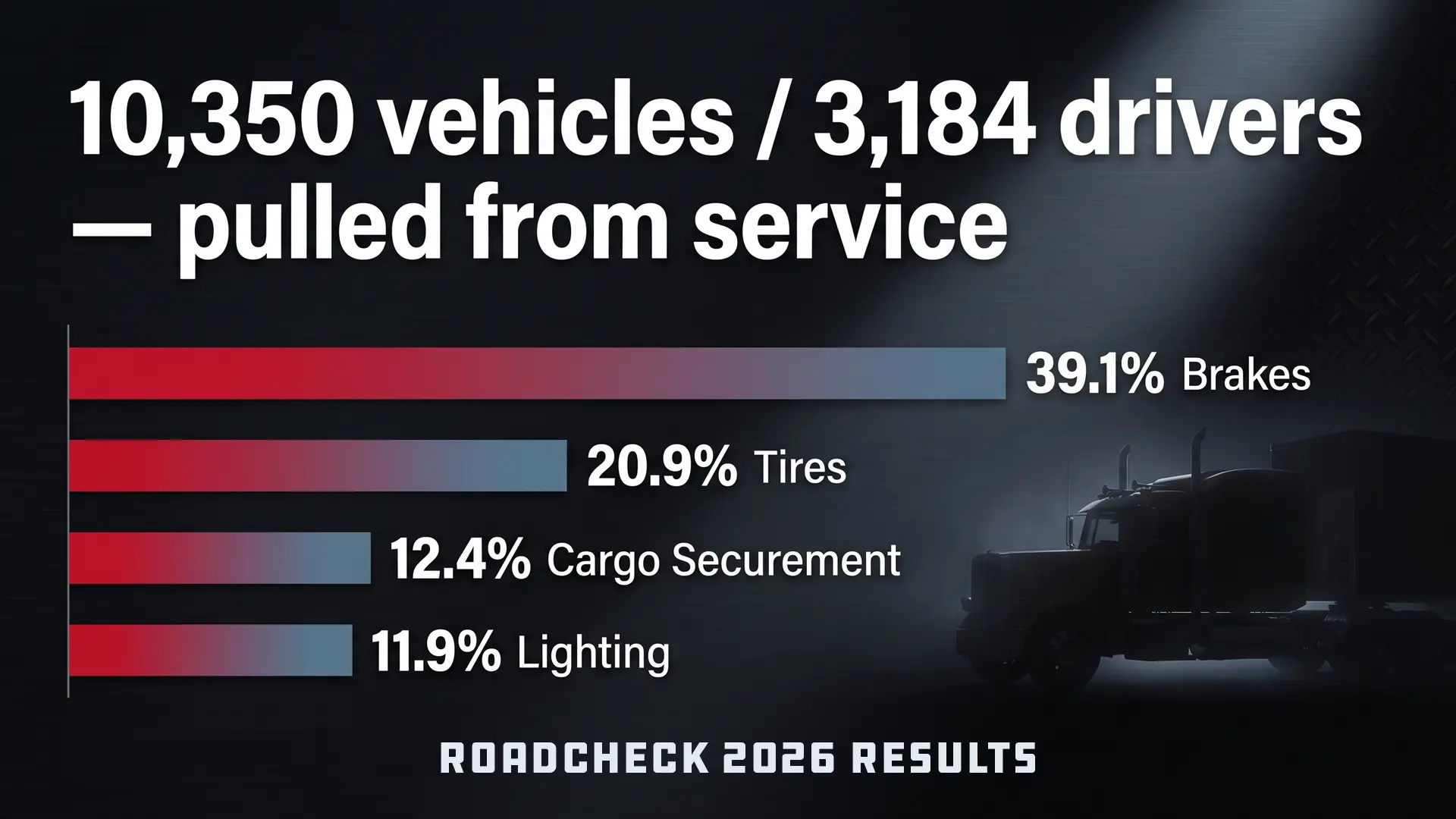
Roadcheck 2026 Results: What 10,000 Grounded Trucks Reveal About Your Fleet’s Risk
During this year's three-day International Roadcheck, certified inspectors conducted 54,575 roadside inspections across the U.S., Canada, and Mexico — and sidelined 10,350 commercial motor vehicles and 3,184 drivers for safety violations serious enough to warrant an...
Looking for a place to teach my 35 year old son and my 18 year old how to drive .I don’t Have the patience lol
Hi Tracy, Please call our HQ: 330.922.3100